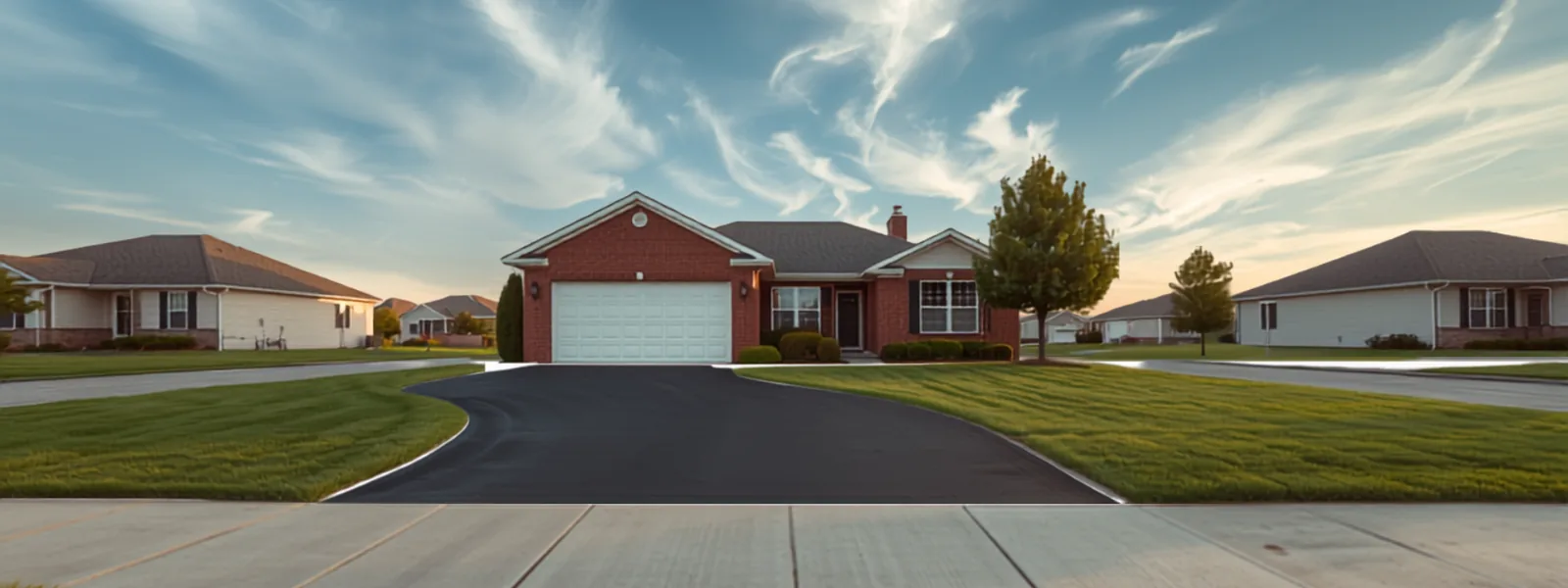
Asphalt Companies in Wichita, KS
Most people searching for asphalt companies in Wichita are not shopping for a hobby. Something has gone wrong — a driveway that has started shedding gravel, a parking lot with a pothole that is now eating trailer tires, an apron at the street that has cracked into pieces you can lift out by hand. Or something is about to go wrong, and you would rather spend a smaller amount of money now than a larger amount later.
Call (316) 368-2270 for a Free QuoteThis page is written to do two jobs. The first is to give you a straight answer about what asphalt work in Wichita actually involves, what makes it last, and what makes it fail — because the difference between a driveway that goes twenty years and one that goes six is almost never the color of the surface on the day it was finished. The second is to make it easy to get a quote. If you already know what you need, call (316) 368-2270 or use the form on this page and we will get you scheduled for a look.
Everything below is about asphalt in Kansas specifically, because Kansas is what makes asphalt in Wichita different from asphalt in Dallas or Phoenix. That difference is the whole story, and it is the part the national directory pages never mention.
What Asphalt Companies in Wichita Actually Do
Asphalt company covers a wider range of work than most people expect, and the range matters, because the right answer for your driveway may be a different service than the one you called about.
Asphalt Paving — new asphalt over a prepared base. This is the full job: excavate, shape and compact the subgrade, build the aggregate base, then lay and roll the asphalt in lifts. New driveways, new sections, and surfaces that have never been paved.
Asphalt Repair — crack filling, pothole patching, full-depth patching, and localized rebuilds. The service most Wichita searches are actually looking for, and the one where waiting costs the most.
Overlay and Resurfacing — a new layer of asphalt laid tight over the existing surface, usually after milling the edges so the new surface ties into the garage, the street, and the sidewalks at the right height. The middle option between patching and starting over.
Driveway Replacement — removing the old surface and, when the problem is underneath, the failed base along with it, then rebuilding from the subgrade up. The right call when the damage is structural rather than cosmetic.
Sealcoating — a protective coat over sound asphalt that slows oxidation and keeps water out of the surface. Maintenance, not repair. It will not fix a structural problem, and anyone telling you it will is selling you the wrong thing.
Parking Lot Paving — commercial lots, drive aisles, loading areas, and the striping and traffic layout that goes with them. Different loading, different thickness, different sequencing, because the lot generally cannot close.
If you are not sure which of those you need, that is a normal place to start. Describing what you are seeing — where the cracking is, whether water stands after rain, whether the edges are crumbling — usually narrows it down fast.
Asphalt Paving
Asphalt Paving for homes and property in Wichita and Sedgwick County.
Asphalt Repair
Asphalt Repair for homes and property in Wichita and Sedgwick County.
Driveway Replacement
Driveway Replacement for homes and property in Wichita and Sedgwick County.
Overlay & Resurfacing
Overlay & Resurfacing for homes and property in Wichita and Sedgwick County.
Sealcoating
Sealcoating for homes and property in Wichita and Sedgwick County.
Parking Lot Paving
Parking Lot Paving for homes and property in Wichita and Sedgwick County.
Parking Lot Striping
Parking Lot Striping for homes and property in Wichita and Sedgwick County.
Why Kansas Freeze-Thaw Decides How Long Your Asphalt Lasts
Here is the mechanism, because once you understand it every other decision on this page becomes obvious.
Water expands roughly nine percent when it freezes. That is not much in a glass. It is an enormous amount inside a crack in a driveway, because the crack cannot get bigger in any direction except by breaking more asphalt.
Wichita sits in the part of the country where winter temperatures do not simply drop below freezing and stay there until spring. They cross the freezing line, back and forth, over and over — warm afternoons, hard overnight lows, and repeat. Every crossing is a cycle. Water gets into a hairline crack during the thaw, freezes overnight, expands, and pushes the crack wider. Then the ice melts and drains deeper, and the next freeze happens a little further down.
A hairline crack in October that nobody fills is a quarter-inch crack in January and a pothole in March. That is not neglect. That is physics working on a surface that was left open.
The same cycle attacks the base. Once water gets past the asphalt and into the aggregate underneath, freezing lifts the base, thawing drops it, and the support the asphalt depends on gets loose and uneven. When the base moves, the asphalt above it flexes, and flexing asphalt cracks in a spiderweb pattern — the alligator cracking that is the single most reliable sign that the problem is no longer on the surface.
Three practical consequences follow, and they drive everything. First, sealing a crack is cheap and rebuilding a base is not, so the entire economics of asphalt maintenance in a freeze-thaw climate come down to keeping water out before it gets underneath. Second, damage shows up in spring but it was caused all winter — March and April are when Wichita driveways suddenly look terrible, and they did not fail in March, March is only when you can see it. Third, drainage is a bigger deal here than the asphalt itself, because water that stands on a surface has time to find a way in and water that runs off does not. A surface with correct fall will outlive a thicker surface that ponds, every single time.
A national directory page cannot write that section about your market, because it is not written about anywhere in particular. That is the difference between a list of phone numbers and a company that works here.
How to Compare Asphalt Companies in Wichita
You are probably going to get more than one quote. Good — you should. But asphalt quotes are notoriously hard to compare, because two bids for a new driveway can describe wildly different amounts of work at prices that look close together. Here is what to actually look at.
Ask what the base is, not just what the surface is
The asphalt is the part you see and the smaller part of the job. What holds a driveway up is the compacted aggregate base underneath it and the subgrade under that. A bid that specifies the base depth and says the subgrade will be compacted is describing a different job than a bid that only mentions the asphalt. If a quote does not mention the base at all, ask. The answer tells you a lot.
Ask about thickness, in compacted inches
Asphalt is laid loose and rolled down. A three-inch driveway can mean three inches loose, which compacts to noticeably less. Ask for compacted thickness, and ask whether it is going down in one lift or two. Thicker is not automatically better if the base is wrong, but thin over a weak base is a guaranteed problem.
Ask how they are handling water
Where does the water go? On a driveway that usually means the slope away from the garage and the transition at the street. On a lot it means where the low points are and whether they are where you want them. If nobody on the bid has said a word about drainage, they have skipped the part that determines the lifespan.
Ask what happens at the edges
Asphalt fails at its edges first, because an edge has nothing holding it laterally. How the new surface ties into the garage slab, the street, the sidewalk, and the yard is where a lot of otherwise-good driveways start to go. Ask.
Get it itemized
A single number for the whole job makes comparison impossible. Excavation, base, asphalt, compaction, tie-ins, and cleanup should be visible as separate lines, or at minimum described in writing. Then two bids can be compared on what they contain instead of on which is smaller.
Be careful about the truck that shows up in your driveway
This one is worth stating plainly, because it happens every season in Kansas and it costs people real money. The pitch is some version of: we were paving a job down the road, we have leftover material on the truck, we can do your driveway right now at a discount if you pay cash today. Sometimes there is a clipboard. There is usually urgency, and the price is usually great.
What arrives is often cold or partially cooled material, spread thin over whatever was already there, with no base work, no compaction that matters, and nobody to call in the spring. It looks finished for about one winter. A real quote is not an emergency. Nobody doing careful asphalt work needs a decision from you in the next ten minutes, and if a company cannot leave a written scope with you and come back, that is the answer to your question about that company.
What a straight answer sounds like
The single best signal is a company that will tell you not to do something. If your driveway needs crack filling and a quote comes back for a full replacement, ask why. Sometimes there is a very good reason and it is visible once explained. Sometimes there is not. Either way, the company that will walk you through the reasoning is the one worth having. We would rather tell you a surface has three good years left in it and seal it than sell you a rebuild you do not need yet.
Repair, Resurface, or Replace: How the Decision Gets Made
Almost every asphalt call in Wichita is really this question. Here is the framework.
Repair is right when the damage is local and shallow. Individual cracks, a pothole or two, a patch where a spot has broken up, an edge that has crumbled. The rest of the surface is sound and still sheds water. Filling and patching buys years for a fraction of the cost of anything else, and in a freeze-thaw climate it is the highest-return money you will spend on asphalt.
Resurface is right when the surface is worn out but the base is good. The asphalt is gray, oxidized, maybe raveling — losing its fine aggregate and turning gritty — with cracking that is widespread but not yet structural. There are no soft spots, nothing sinks under load, and water does not stand. An overlay laid tight to the old surface gives you a new wearing course without rebuilding what is underneath.
Replace is right when the base has failed. The tells are consistent: alligator cracking across large areas, spots that visibly deflect or feel spongy when a vehicle rolls over them, potholes that come back in the same place after being patched, and water that stands in depressions that keep getting deeper. Once the base is moving, anything laid over it is a temporary surface on a permanent problem.
The mistake that costs the most money is resurfacing over a failed base. It looks perfect the week it is finished and the same cracks come back through the new surface, sometimes within a year. If the base is bad, an overlay is money spent to delay a conversation. The second mistake is replacing something that only needed sealing. That one is less common and easier to avoid — get a second opinion whenever the recommendation jumps straight to a rebuild on a surface that still looks reasonably intact.
What Asphalt Work Costs in Wichita
Cost depends on things you can actually see, which is why nobody can quote an asphalt job over the phone without at least knowing the size. The drivers, in roughly the order they matter: square footage, which is the obvious one and the reason bigger jobs get cheaper per square foot as mobilization spreads further; whether the base needs work, which is the largest single swing in any asphalt quote, because surface-only work and full-depth rebuilding are different jobs at very different prices; removal and haul-off, since tearing out and disposing of an existing surface adds cost a first-time pave does not have; and access, meaning how the equipment gets in, whether there is room to maneuver, and what has to be protected on the way.
After those come thickness, since driveways and lots that take truck traffic need more asphalt than driveways that take a sedan; drainage corrections, because if water is currently going the wrong way then fixing that is part of the job and it is worth paying for; and season, because asphalt is temperature-sensitive to place and compact, which compresses the Kansas calendar and makes the good weeks busy.
There is a longer breakdown of how these stack up on a residential job on the asphalt driveway cost in Wichita page. For anything specific, the honest answer is a look at the surface. Call (316) 368-2270 and we will come measure it.
When to Schedule Asphalt Work in Kansas
Timing matters more here than it does in a mild climate.
Spring is when the damage becomes visible and when the phone rings hardest. It is also when the ground is often still wet, which affects base work. Early spring is excellent for assessment and for getting on a schedule.
Late spring through early fall is the working season. Warm ambient temperatures give the mix time to be placed and compacted properly, which is the single largest quality variable in a paving job that nobody ever sees happening.
Fall is the best time for crack filling and sealcoating, and this is the most underrated sentence on this page. Sealing before winter is what stops the freeze-thaw cycle from having anything to work with. Filling a crack in October is preventing a pothole in March.
Winter is limited for anything involving new asphalt. Cold-patch repairs can keep a hole from getting worse until it can be done properly, but they are a stopgap by design, not a fix.
If you are reading this in late summer or early fall and you have cracks, that is the moment. Not because of a sale — there is not one — but because of the calendar.
Getting a Quote
Tell us what you are seeing and where. Photos help a lot, especially for repair questions, and they often shorten the whole conversation. From there we will come look at the surface, measure it, and put the scope in writing so you can compare it against anything else you are holding. Call (316) 368-2270, or send the details through the form on this page.
Serving Wichita
We work across Wichita. In College Hill and Riverside the houses date from the twenties and thirties and the drives serving them are narrow, original, and often run the length of the lot to a detached garage at the back — a long thin slab over clay that has been moving under it for ninety winters, which is why those drives crack in the same places. Delano and the older streets west of the river carry the same age with less room to work in. Around Old Town and downtown the surfaces are commercial and access is the constraint: alley approaches, loading traffic, and nowhere to stage material. Along the Douglas Design District the lots are small and the frontage is the storefront, so a resurface has to look right the day it opens.
Outside the city we keep separate pages for Maize, Goddard, Park City, Derby, Haysville and Andover.
Frequently Asked Questions
How long should an asphalt driveway last in Wichita?
A properly built driveway on a good base, kept sealed and with its cracks filled, is a long-term surface — the kind of thing you maintain rather than replace. The same driveway on a thin or poorly compacted base in a freeze-thaw climate can be in trouble in well under a decade. The base and the maintenance are doing almost all of the work in that difference, not the grade of asphalt on top.
Is sealcoating actually worth it, or is it just a sales add-on?
It is worth it on sound asphalt and worthless on failing asphalt, which is why it has a mixed reputation. Sealcoat slows oxidation and keeps surface water out of a surface that is otherwise intact. It does not add structure, it does not bridge a moving crack, and it will not fix alligator cracking. Applied to the right surface at the right time it is the cheapest year of life you can buy. Applied to the wrong one it is paint over a problem.
Can you just fill the cracks instead of doing the whole driveway?
Very often, yes — and if that is the right answer we will say so. Crack filling is the single highest-return maintenance in a Kansas winter climate because it interrupts the freeze-thaw cycle before it reaches the base. The limit is structural: once cracking is widespread and interconnected, filling individual cracks stops being the fix and starts being a way to postpone one.
Why does the same pothole keep coming back after it gets patched?
Because the problem is underneath it. A pothole is the visible end of a base failure — water got below the asphalt, the support washed out or moved, and the surface collapsed into the void. Filling the hole replaces the surface without addressing the void, so the next freeze-thaw season opens it again. A repair that lasts goes full depth and rebuilds what is under it.
What is alligator cracking and how bad is it?
It is interconnected cracking in a pattern of small polygons, and it means the asphalt is flexing under load because the base is no longer supporting it evenly. It is the most reliable visual sign that the problem has moved below the surface. Small isolated areas can be cut out and rebuilt. Widespread alligator cracking usually means the surface is at the end of its useful life.
How soon can asphalt be driven on?
Passenger vehicles can generally be back on new asphalt fairly quickly, but new asphalt stays soft and continues to cure for a while, and it is most vulnerable in hot weather. Sharp turns while stopped, jack stands, motorcycle kickstands, and trailer jacks will all leave marks in a new surface long after it feels hard. We will give you specific timing for your job and the weather it was placed in.
Do I need to replace my driveway if water stands on it?
Not necessarily, but it needs to be looked at. Standing water is a symptom, and the question is whether it stands because of a low spot in a surface that is otherwise fine, or because a depression is forming over a base that is settling. Those two look similar from standing height and have very different answers. Ponding on asphalt in a freeze-thaw climate is not something to leave alone either way.
Can you work on a parking lot without shutting the business down?
Ask about phasing. Most lots can be sequenced in sections so there is always access and always parking, and the plan for that should be part of the quote rather than a surprise on the first morning. Tell us the hours you cannot lose and the layout gets built around them.
What is the difference between asphalt and blacktop?
Nothing meaningful — they are the same material, and which word gets used is mostly regional habit. Blacktop tends to show up more in residential conversation and asphalt more in commercial specs, but a company using either word is describing the same thing.
Are asphalt driveways cheaper than concrete?
Asphalt is typically less expensive to install and easier to repair and resurface, and it flexes with ground movement instead of cracking rigidly — which matters a great deal on ground that heaves and shrinks the way Sedgwick County clay does. It does need maintenance that concrete does not, specifically sealing and crack filling. The right answer depends on the site and on how you feel about periodic upkeep versus a larger up-front number.
Do you offer free estimates in Wichita?
Yes. Estimates are free and come with no obligation. We come out, look at the driveway or lot, check the grade and how water moves across it, and give you a straight number — because what a surface needs underneath, and what it will cost, simply cannot be told from a photograph, least of all on clay.
What areas do you serve?
We serve Wichita — College Hill and Riverside, Delano, Old Town and downtown, and the Douglas Design District. We also keep separate pages for Maize, Derby, Andover, Goddard, Park City, Haysville.
Get a Free Wichita Paving or Repair Quote
Free, no-obligation estimates across Sedgwick County. Tell us about your driveway, your cracks and potholes, or your lot.
Call (316) 368-2270